Showing posts with label seabirds. Show all posts

Tuesday, June 28, 2011

KLEPTOPARASITISM


Kleptoparasitism: 

klepto: Greek κλέπτης ("thief") and κλέπτω ("steal") + parasitos: παράσιτος ("person who eats at the table of another")

Meaning: The parasitic theft of captured prey, nest material, etc., from animals of the same or another species; such as the theft by a gull* of a featherwight GoPro camera from a tourist on the French Riviera.

*Possibly a European herring gull (Larus argentatus).

(European herring gull. Credit: Kulac via Wikimedia Commons.)

The gull video reminded me of another wild travel video shot by a sea turtle on a "stolen" underwater camera.


The sea turtle video is more likely a case of entanglement than of kleptoparasitism.

Monday, May 9, 2011

AN EXCELLENT YEAR ON RASA ISLAND

(Isla Rasa, Mexico, view from the hut, looking out over the estero. Photo ©Julia Whitty.)

I'm finally back from Mexico's remote Isla Rasa, a tiny outpost in the Gulf of California and one of the most important seabird breeding islands in the world.

The island covers a bare 138 acres/56 hectares. Yet it's home to half a million birds—many more if it's a good enough year for the birds to produce eggs, incubate them, and hatch their chicks.

(Heermann's gulls and a cardón cactus, both endemic to the Gulf of California and the Baja Peninsula. Photo ©Julia Whitty.)

Some 95 percent of all Heermann's gulls (Larus heermanni) nest on Isla Rasa. These are small, pretty, polite gulls—compared to some of their larger Larid relatives.

Heermann's gull: 
  • length 19 inches/48 centimeters
  • wingspan 51 inches/129 centimeters
Great black-backed gull: 
  • length 30 inches/76 centimeters
  • wingspan: 65 inches/165 centimeters

(Grand Central Station Valley, Isla Rasa, Mexico. Photo ©Julia Whitty.) 

In the photo above, you can see the nesting territories of the gulls dotting the island's valleys. 

Gulls also nest throughout the rocky hillsides and ridgelines.

(Heermann's gull. Photo ©Julia Whitty.)

In fact Heermann's gulls nest on every square inch of this sunbaked, windswept island—except where thickets of cholla cactus have taken hold... and where colonies of terns have usurped them.


(Elegant tern colony in the midst of Heermann's gulls, Isa Rasa, Mexico. Photo © Julia Whitty.)

In the photo above you can see how in one valley elegant terns (Thalasseus elegans) have successfully muscled into the territories of gulls. 

(Elegant terns, Isla Rasa, Mexico. Photo ©Julia Whitty.)

The terns nest closer together than the gulls. 

This, and the fact that they move into gull territories en masse and often under cover of night, means they generally get what ground they want—even though they're smaller birds:

Heermann's gull: 
  • length 19 inches/48 centimeters
  • wingspan 51 inches/129 centimeters

Elegant tern:
  • length 17 inches/43 centimeters
  • wingspan 34 inches/86 centimeters

(Heermann's gulls and elegant terns, Isla Rasa, Mexico. Photo ©Julia Whitty.)

Here's what the two species look like nesting side-by-side.

You can probably already tell from the numbers of birds in the photos that's it's been a very good year so far on the island.

(Heermann's gull chick and eggs. Photo ©Julia Whitty.)

By the time I left, chicks were hatching everywhere and the whole island was transformed from the calm (in comparison) business of incubating to the furious business of feeding tiny insatiable stomachs.

In a forthcoming Mother Jones article I'll be writing more about why this year may be the best for the Gulf's seabirds since the mid-19th century. 


(Photo ©Julia Whitty.) 

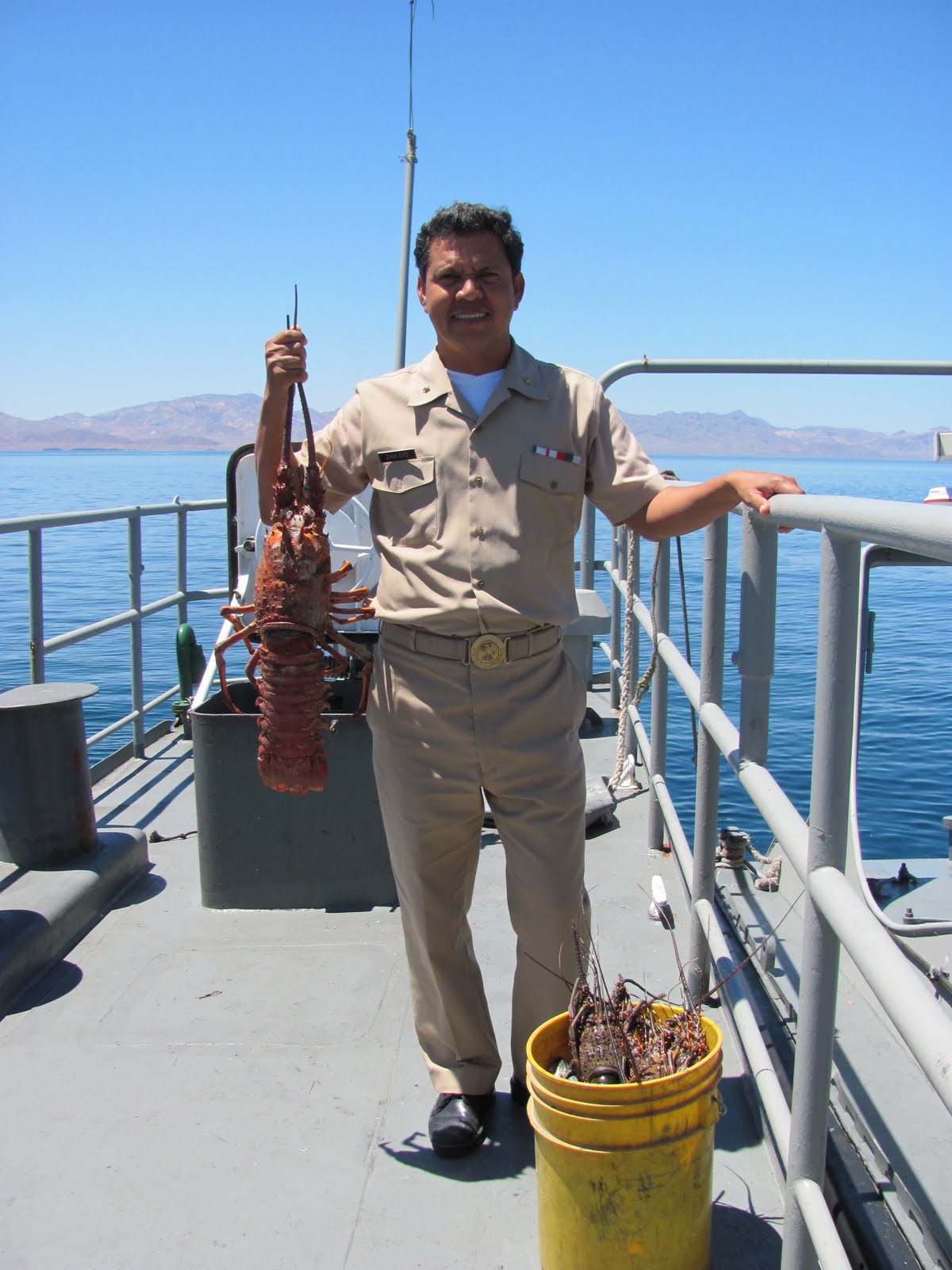
Plus why it took me longer to get home than I imagined... part of my odyssey aboard a Mexican navy ship.

Monday, March 21, 2011

OCEAN BIRDS

American white pelican, Pelecanus erythrorhynchos. Photo by Manjith Kainickara via Wikimedia Commons.


Northern gannet, Morus bassanus. Photo by Andreas Trepte via Wikimedia Commons.

Great crested tern, Thalasseus bergii. Photo by Martin Pot (en:User:Martybugs) via Wikimedia Commons.

Atlantic Puffin, Fratercula arctica. Photo by Thomas O'Neil via Wikimedia Commons.

Blue-footed booby, Sula nebouxii. Photo by Rileypie via Wikimedia Commons.


Rockhopper penguin, Eudyptes chrysocome. Photo by Ben Tubby via Wikimedia Commons.


Spectacled eider, Somateria fischeri. Photo by Laura Whitehouse, courtesy USFWS, via Wikimedia Commons.

Long-tailed duck, Clangula hyemalis. Photo by Wolfgang Wander via Wikimedia Commons.


Penguin, via.


Unknown, via unknown (saltwater or fresh?).

Red phalarope, Phalaropus fulicarius. Photo by Andrei Taranchenko via Wikimedia Commons.

Smew, Mergellus albellus. Photo by Thermos via Wikimedia Commons.

White-faced storm-petrel, Pelagodroma marina. Photo by Aviceda via Wikimedia Commons.


Sanderlings, Calidris alba. Photo by Mbz1 via Wikimedia Commons.

Australasian gannets, Morus serrator, on the nest. Photo by Follash via Wikimedia Commons.

Common murres, Uria aalge, colony. Photo by Duncan Wright via Wikimedia Commons.

Ivory gull, Pagophila eburnea. Photo by jomilo75 via Wikimedia Commons.

Far eastern curlew, Numenius madagascariensis. Photo by 
Duncan Wright courtesy USFWS, via Wikimedia Commons.

Thursday, March 17, 2011

UPDATE: WISDOM SURVIVED!

(Photo from Wild Encounters. Many other beauties here of albatross and the ever-lovely fairy terns. Well worth a visit.)

Many thanks to friends and readers who pointed out this BBC article reporting that Wisdom, a 60-year-old Laysan albatross mother, survived the tsunami that killed many thousands of birds on Midway Atoll. 

I'm guessing that Wisdom's part of the atoll wasn't submerged...? I'm hoping her chick survived too...?

Seems to me the world could use more Wisdom DNA.

Wednesday, March 16, 2011

DID THE TSUNAMI KILL "WISDOM?"


(Laysan albatross Wisdom, seen here with her chick at Midway Atoll, March 2011, before the tsunami. Credit: John Klavitter/U. S. Fish and Wildlife Service, via Wikimedia Commons.)

I've tweeted a few times of late about the remarkable Laysan albatross named Wisdom. She's at least 60 years old—the oldest-known wild bird in the US. 

A few months ago she returned to Midway Atoll in the northwestern Hawaiian Archipelago, found her mate, laid an egg, and recently hatched a chick. 

Now the Honolulu Star-Advertiser reports that tsunami waves from Japan's massive quake devastated Midway's seabird breeding rookeries, completely washing over one of the islands and partially submerging the other two. Tens of thousands of albatrosses died, adults and chicks. 

(Calculated wave height of the 2011 tsunami originating near Sendai, Japan.  Credit: NOAA.)

If you click on the image above you'll see the larger version, with the main Hawaiian Islands located in the center-right. The Hawaiian Archipelago tracks west-northwest from there, with Midway just visible near the far end of the island chain, embedded in the high-wave tsunami zone marked in red.

The albatross chicks on Midway were killed by the waves because none have fledged this early in the season. Laysan albatrosses have extremely long dependency periods—64 days of incubation, followed by 165 flightless days before they fledge and leave the island.


(Laysan albatross chicks with a few embedded adults, Midway Atoll. Credit: Mass Communication Specialist 2nd Class Mark Logico, US Navy, via Wikimedia Commons.) 

The adults were likely killed because they don't readily abandon their young.

Plus these are big birds of the open ocean. It takes them a long time to lumber across the water or the beach to get airborne. Midway's old runways turn out to be extremely useful for this purpose.

In the absence of wind, they can't takeoff or land. The Birds of North America Online describes their flight like this:

Depending on wind strength, take-off may be difficult, requiring a long run with the head outstretched, the bird flapping its wings and literally running. Take off from water is similar, requiring furious paddling with the webbed feet. Landings can be equally difficult, especially in birds that have been at sea for months, or in light winds. In the absence of the braking effort of a strong wind, landing birds may occasionally tumble on landing.


Midway is home to about 450,000 of the world's 590,926 breeding pairs of Laysan albatross. The IUCN Red List deems the species Near Threatened.

Some 25,300 black-footed albatrosses also live on Midway Atoll and presumably took some tsunami losses too.

(Black-footed albatross, Midway Atoll. Credit: Forest & Kim Starr, via Wikimedia Commons.)

Plus one pair of short-tailed albatrosses arrived this year. This species breeds on islands off Japan and China and is deemed Vulnerable by the IUCN Red List—with a total global population of only 2,364 individuals. 

A few months ago I tweeted the exciting news that this pair had appeared on Midway—an encouraging sign the species' range might be expanding.

Now, in the wake of the tsunami waves, US Fish and Wildlife officials have found one short-tailed albatross chick, returned it to a nesting area, and installed a remote-controlled camera to monitor it. But they haven't found the parents. 


(Short-tailed albatross. Credit: US Fish and Wildlife Service, via Wikimedia Commons.)

No word yet that I've heard on Wisdom's fate. This late in the breeding season few if any birds will try to lay another egg and start the long cycle again.

Wednesday, March 2, 2011

PRESTIGIOUS CONSERVATION AWARD GOES TO ENRIQUETA VELARDE

(Enriqueta Velarde [right] on Isla Rasa, 1980. Photo by Julia Whitty.)

Those of you who've read my book Deep Blue Home know of my great friendship with Enriqueta Velarde, a scientist at the University of Veracruz's Institute of Marine Sciences and Fisheries. We spent what was for me a profoundly formative field season together on tiny Isla Rasa in Mexico's Gulf of California, aka the Sea of Cortez, in 1980.

The island is home to nearly all the breeding Heermann's gulls and elegant terns on Earth. Their numbers have risen dramatically in recent decades thanks to Enriqueta's devotion and hard work. As I wrote in Deep Blue Home:

Enriqueta has returned to Rasa every spring to live among the birds. She has become one of the foremost voices for the preservation of the wild islands of the Gulf of California. Her presence, her deepening knowledge, have protected this corner of the world far beyond the modest funding she receives.


(Elegant tern, Sterna elegans. Photo by Regular Daddy, courtesy Wikimedia Commons.)
 
So I'm pleased to relay the good news that Enriqueta has been awarded the prestigious Volkswagen for the Love of the Planet Award (Programa Volkswagen, Por Amor al Planeta) for scientific investigation in the field of conservation biology.

From the awards page:

Over more than 30 years of scientific work Dr. Velarde has contributed significantly to the recovery of Rasa Island, one of the most unique ecosystems in the world, located in the Gulf of California... In the early seventies the population of gulls and terns amounted to a few tens of thousands. Today, as a result of the actions and the presence of Dr. Velarde, the number of birds that nest each year on the island is about half a million, its density is so high that have begun to nest on nearby islands.

¡Felicidades, Enriqueta! I can't imagine anyone more deserving.


(Both shots are of the tern colony on Isla Rasa. Photos by Carl Safina. Thanks so much, Carl!)

Saturday, November 27, 2010

ENDLESS SUMMER FOR SEABIRDS

(Streaked shearwater. Photo by marj k Marj Kibby, at Flickr.) 

Shearwaters are long-winged, strong-flying seabirds of the open ocean who come ashore only to breed. The rest of their lives—including the time between fledging and sexual maturity, up to 12 years in some species, maybe more—are spent entirely at sea. They're long-lived birds, with reports of one 55-year-old Manx shearwater still breeding in Ireland as of 2003.

Their time aloft and afloat is not without pattern. The more we learn, the more we see how these oceanic travellers follow vast systems of winds and waves across hemispheres and even oceans.

First up, there's an interesting paper out in the current issue of The Auk about a presumed foraging association between streaked shearwaters (Calonectris leucomelas) and skipjack tuna (Katsuwonus pelamis).

Foraging associations—as the term implies—are the result of a follower species (here, the shearwater) commonly following a nuclear species (here, the tuna) to capture prey flushed in the course of the nuclear's feeding or travels. The deep blue home is full of foraging associations... including the way savvy human fishers follow seabirds to find fish.

(Skipjack tuna. Photo JFontes—ImagDOP, from here.)


(Streaked shearwater at breeding colony on Mikura Island, Japan. Photo by Kanachoro, courtesy Wikimedia Commons.)

A little background: Streaked shearwaters breed on the islands and coastlines of Japan, China, and Korea, and make impressive winter migrations (≤5,400 kilometers /3,300miles) to the waters off Vietnam, New Guinea, the Philippines, and Australia.


(Movement of a streaked shearwater from Japan to the Gulf of Carpentaria, Australia, between 16 October 2004 and 13 January 2005. Figure from Ornithological Science.)

In the figure above you can see the flight of one shearwater between its breeding grounds in the Northern Hemisphere during the boreal summer and its "wintering" grounds in the Southern Hemisphere during the austral summer. Those results are reported in a 2008 paper in Ornithological Science by some of the same members of the shearwater-skipjack team during an earlier phase of study.


(From Ornithological Science.)

In their latest investigations, the researchers attached small global location sensors to 48 breeding birds in 2006, 38 of whom returned the following year with their geolocators intact. Their findings, from the abstract:

Most Streaked Shearwaters wintered off northern New Guinea, an area of low primary productivity but high Skipjack Tuna (Katsuwonus pelamis) abundance. Streaked Shearwaters flew for longer periods and landed on the water more frequently around dawn and dusk during the wintering period. This pattern of activity is similar to that of subsurface predators such as tuna, and to that of tropical seabirds that are known to feed with subsurface predators. We suggest that Streaked Shearwaters probably forage in association with subsurface predators in the tropical oceans during the wintering period. Foraging in association with subsurface predators and morphological adaptations for gliding may allow Streaked Shearwaters to forage efficiently in both temperate and tropical environments.


(You might have to divert here to watch the video.)

This Blue Planet video shows the dynamics of shearwaters (not sure which species) working schools of mackerel herded up to the surface, initially by dolphins, then by skipjacks... I love the way they've mixed shearwater calls into the underwater video—dramatic, but inaccurate, at least to the extent heard here.

(Sooty shearwaters. Photo by marlin harms, courtesy Wikimedia Commons.)

In an incredible piece of scientific detective work a few years back, a different team of researchers found that another species, sooty shearwaters (Puffinus griseus), embarked on remarkable 64,000-kilometer/40,000-mile annual migrations through the entire basin of the Pacific Ocean from Antarctica to the Bering Sea—the longest migration of any animal tracked to that point.

(From PNAS.)

Their map shows the geolocation tracks of 19 of their tagged sooty shearwaters at New Zealand breeding colonies (light blue); their migration pathways north (yellow); and their wintering grounds and southward transits (orange). Figures b–d represent the figure-eight movement patterns of individual shearwaters travelling to one of three "winter" destinations in the North Pacific.

The authors suggest the figure-eight  pattern is facilitated by prevailing wind patterns and by the Coriolis effect—which influence the long-range trajectories of the birds as they rocket between hemispheres at rates of up to 910 kilometers/565 miles a day, and as they chase the waves of summer from one hemisphere to the other.

(Credit: NASA/Seasat.)

You can correlate something of the travels of the sooty shearwaters to this map of prevailing winds over the Pacific.

The 2006 sooty shearwater paper appeared in Proceedings of the National Academy of Sciences. From the abstract:

Electronic tracking tags have revolutionized our understanding of broad-scale movements and habitat use of highly mobile marine animals, but a large gap in our knowledge still remains for a wide range of small species. Here, we report the extraordinary transequatorial postbreeding migrations of a small seabird, the sooty shearwater, obtained with miniature archival tags that log data for estimating position, dive depth, and ambient temperature. Tracks (262 ± 23 days) reveal that shearwaters fly across the entire Pacific Ocean in a figure-eight pattern while traveling 64,037 ± 9,779 km roundtrip, the longest animal migration ever recorded electronically. Each shearwater made a prolonged stopover in one of three discrete regions off Japan, Alaska, or California before returning to New Zealand through a relatively narrow corridor in the central Pacific Ocean. Transit rates as high as 910 ± 186 km·day−1 were recorded, and shearwaters accessed prey resources in both the Northern and Southern Hemisphere’s most productive waters from the surface to 68.2 m depth.
But now the flying record of the sooty shearwaters been topped by a diminutive seabird, the Arctic tern, who not only crosses hemispheres but ocean basins as well.


(From PNAS.)

These are the geolocation tracks of 11 Arctic terns tracked from breeding colonies in Greenland and Iceland. The green lines are their autumn postbreeding migration (August–November). The red their "winter" range (December–March). The yellow their spring return migration (April–May). Two southbound migration routes are adopted in the South Atlantic, either (A) West African coast or (B) Brazilian coast. Dotted lines link locations during the equinoxes.

The research is reported in a February 2010 paper in PNAS, revealing migrations for Arctic terns of more than 80,000 kilometers/48,000 miles a year.


(Arctic tern. Photo by Malene Thyssen, courtesy Wikimedia Commons.)

Such globe-trotting transits keep these butterflies-of-the-sea hopped up on the endless summers of the high-latitudes. They barely know night.


The papers:
  • Takashi Yamamoto, et al. At-Sea Distribution and Behavior of Streaked Shearwaters (Calonectris leucomelas) During the Nonbreeding Period. The Auk. 2010. 127 (4) 871–881. DOI: 10.1525/auk.2010.1002. 
  • ♥ Akinori Takahashi. Post-breeding movement and activities of two Streaked Shearwaters in the north-western Pacific. Ornithological Science. 2008. 7 (1) 29-35. DOI: 10.2326/osj.7.29. ♥
  • ♥ Scott A. Shaffer, et al. Migratory shearwaters integrate oceanic resources across the Pacific Ocean in an endless summer. PNAS. 2006. 103 ( 34) 12799-1280. DOI: 10.1073/pnas.0603715103. ♥
  • ♥ Carsten Egevang, et al. Tracking of Arctic terns Sterna paradisaea reveals longest animal migration. PNAS. 2010. 107 (5) 2078-2081. DOI: 10.1073/pnas.0909493107. ♥
I ♥ open-access papers.

    Sunday, November 14, 2010

    SUNDAY POETRY: "SEA-WARD, WHITE GLEAMING..."


    (Common gull, or mew gull, or sea-mew, or Larus canus. Photo by Tomasz Sienicki, courtesy Wikimedia Commons.)

    by Samuel Taylor Coleridge

    Sea-ward, white gleaming thro' the busy scud
    With arching Wings, the sea-mew o'er my head
    Posts on, as bent on speed, now passaging
    Edges the stiffer Breeze, now, yielding, drifts,
    Now floats upon the air, and sends from far
    A wildly-wailing Note.

    Friday, October 8, 2010

    RANDOM EXCERPT: FILMING FROM THE BLUFFS

    (Colony of northern gannets at Cape Saint Mary's Ecological Reserve, Newfoundland. Photo by Bigg(g)er, courtesy Wikimedia Commons.)  

    Cape Saint Mary's Ecological Reserve on the island of Newfoundland is one of my favorite places on Earth. 


    Look at the monster continental shelf all around it. That's none other than the Grand Banks, the fishing grounds that fueled Europe for 500 years. 

    Cape Saint Mary's lies on a point of land between fjords. In bird-world economics, that's like living between Costco and Home Depot.

    (Photo by Johnath, courtesy Wikimedia Commons.) 

    Only way bettah.


    (Capelin spawned out on a beach in Newfoundland. Photo by Litehouseman, courtesy Flickr.) 

    The birds are here for these waters' many piscivorous banquets, including the annual capelin feast: aka, the spawning run, known locally as the scull. This is the time each summer when capelin by the millions head up onto dry land to spawn.

    More on that in a later post.


    (Atlantic puffin with capelin off Newfoundland. Photo by Nilfanion, courtesy Wikimedia Commons.)

    (A mated pair of northern gannets performing their courtship display, including fencing with their bills. Photo by naturepicsonline, courtesy Wikimedia Commons.)

    Cape Saint Mary's is widely recognized as one of the most accessible seabird rookeries in the world, where you can see—from dry land and from as little as 30 feet away—spectacular aggregations of northern nesters:
    • 24,000 northern gannets
    • 20,000 black-legged kittiwakes
    • 20,000 common murres
    • 2,000 thick-billed murres
    • 200 razorbills
    • black guillemots
    • double-crested cormorants 
    • great cormorants
    • northern fulmars
    (Northern gannet with nesting material. Photo by Andreas Trepte, courtesy Wikimedia Commons.)


    (Razorbill, in similar nesting conditions to Cape Saint Mary's, in Westfjords, Iceland. Photo courtesy Wikimedia Commons.)

    (Black guillemot at Oban Harbour, Scotland. Photo by Kelson, courtesy Wikimedia Commons.)

    Here's an excerpt about time I spent at Cape Saint Mary's. From DEEP BLUE HOME.
    Filming from the bluffs, we are buffeted by the collective voice of the birds, as rough as the sea below and likewise rising, cresting, breaking into squawks, chuckles, squalls, trills, shouts. Dr. Charles W. Townsend, visiting the gannets in 1919, described their calls as "the sound of a thousand rattling looms in a great factory."
    Thousands of long-winged, long-tailed birds are woven onto the wind, white crosses billowing on veils of fog. Heads down or cocked to the side, the gannets call to their mates below, sifting through the mayhem for familiar return calls, their personal homing beacons. When heard, the receiving bird retracts its wings, extends its legs, and drops—as light as a falling handkerchief that neatly folds itself upon landing.
    The great looms of the gannets are joined by other calls: the breaking-glass kitt-ih-wake! of the kittiwakes; the purring and moaning of turrs—Newfoundland for murres; the grumpy growling of razorbills; the piping and hissing of guillemots; the strangled croaks of cormorants; the adenoidal cackling of fulmars. Add to these the high-pitched peeps of chicks, including those still in the egg, yet already talking to their parents (as with the murres), and you have a fully fledged United Nations of multispecies languages—as if all the tongues you heard on the New York City subway were not just of humans but also our relatives, gorillas, chimpanzees, bonobos, orangutans, gibbons, macaques, baboons, complete with their children in utero and ex utero... a loud, loquacious, repetitive, insistent, hurried, harried, and vital discourse.
    We capture as many dramas as we can crowd onto our limited allotment of film, the courtships, the copulations, the pipping of eggs, the chicks diving into the gullets of their parents, the parents diving into the thrashing waters, the varieties of flight in all its aerodynamic design, stretched on the stop-motion of the wind. With long lenses we investigate the nests of diving birds on the cliffs below in search of interesting finds from the deep. To the north, off the coast of Labrador, fishermen report nests full of pocketknives, smoking pipes, hairpins, and ladies combs, salvaged by cormorants diving onto the wrecks of old trading vessels.


    (Double-crested Cormorant in breeding plumage. Photo by Mike Baird, courtesy Wikimedia Commons.)


    The video is of Cape gannets—close relatives of northern gannets—feeding on the sardine run off South Africa. I had the good fortune years ago to work with the first South African film crew to land this spectacle on celluloid.


    Seeing that clip was so rudely edited in mid-action, here's another.


    Older film footage, but really lovely. You can see the great buoyancy of these birds and the world of wind they inhabit.

    My Ping in TotalPing.com