Showing posts with label video. Show all posts

Thursday, August 18, 2011

THE SEA FREEZES, THE EARTH ERUPTS


The filmmaker asks that we be patient in watching this 8-minute film, which took him a year to shoot and several more months to edit and color grade. The setting is Iceland.


Monday, July 18, 2011

THE SECRET WORLD OF SAND


Maybe because I spent so many years filming on the Little Bahama Banks, I love the sandy-bottom ocean world. It looks empty, but isn't. 

Everything that emerges, submerges, appears, disappears, swims through frame, or swims out, is highlighted against a perfectly minimalist backdrop that looks featureless, but isn't.

Thursday, July 7, 2011

Thursday, June 30, 2011

RIGHT WHALES DECODED

(Southern right whale. Credit: © Brian J. Skerry / National Geographic Stock. Via the World Wildlife Fund.)

An interesting new paper in MEPS (Marine Ecology Progress Series) on the southern right whales of New Zealand and Australia.

Background: All right whales, north and south, were taxed hard and early by human whalers—the "right" whales to hunt because their high blubber content made them likely to float after death and because they frequented near-shore waters.

That made them easy to get to even in the days of rowing.

(A painting, artist unknown, showing the hunting of right whales. La Baleine. The Whale, circa 1840. Credit: Wikimedia Commons.)

Some 150,000 Southern Hemisphere right whales (Eubalaena australis) were killed by 19th-century whalers and by illegal 20th-century Soviet whalers—driving the species to the brink of extinction.

Around Australia and New Zealand, hunting peaked in the 1830s-1840s, after which the species was commercially extinct.


(Geographic range of the southern right whale. Via the Red List.)

The latest IUCN estimate of southern right whales dates back to 1997 when they calculated a population of 7,500 individuals. 

At that time, several breeding populations (in Argentina/Brazil, South Africa, and Australia) showed evidence of strong recovery, with a doubling time of 10-12 years.

Which means there might be a fair few more than 7,500 whales today.


(Southern right whale with calf. Credit: John Atkinson. Via Marine Science Today.)

According to the authors of the MEPS paper, no right whales were seen in the waters around mainland New Zealand for 35 years between 1928 and 1963. A few slowly returned. Yet as recently as 2005 less than 12 sexually mature females were found there.

But another group, known as the New Zealand subantarctic group, has a more robust population estimated at about 936 whales today. Forebears of this group were likely present in some small numbers even in the bleakest killing years.


(Credit: E. Carroll, et al, via MEPS.)

The authors of the MEPS paper wondered about the levels of relatedness between those two whale stocks in New Zealand, as well as among whales in Australia.

They used mitochondrial DNA and microsatellite genotypes to identify 707 individual whales and test them for genetic differentiation. You can see the breakdown of that analysis in the graphic above.

Their data, combined with historical evidence, led the researchers to hypothesize that individuals from the NZ subantarctic are slowly recolonizing mainland New Zealand waters, where a calving ground was obliterated in the 19th century.


(Southern right whale. Via.)

The genetic evidence also suggests that the whales of southeast Australian are a remnant stock—different from the whales of southwest Australia:


At the onset of whaling, southern right whales, in particular cows with calves, were found across the southern coast of Australia during the austral winter (IWC 1986). There was no real discontinuity in distribution or catch records to suggest subdivision of calving grounds in this region (IWC 1986). Based on the timing of catches at shore whaling stations during the 19th century, Dawbin (1986) proposed that southern right whales undertook 2 distinct patterns of migration along the southern coast of Australia during the austral winter. The southern right whales that migrated north along the east coast of Tasmania [the small island off the southeast tip of Australia, as seen in the graphic above] moved in a northeasterly direction up the coast of Victoria and New South Wales, while those that migrated north along the west coast of Tasmania moved from east to west along the southern coast of South and Western Australia. The latter pattern is still extant, based on the movement of photo-identified southern right whales and has been termed the 'counter-clockwise' migratory pattern (Kemper et al. 1997, Burnell 2001).


(The Southern Ocean. Credit: Connormah via Wikimedia Commons.)

They also found evidence that New Zealand and Australian right whales mingle in higher-latitude summer feeding grounds each austral spring—making the health of those cold Southern Ocean waters as important a component of recovery as the whales' breeding efforts.

And what epic efforts they are. Imagine a 12-foot-long penis—known colloquially as a sea snake—plus a tons' worth of testes per male. Mating becomes a sport of endurance. And sperm competition.

But you don't have to imagine it. As usual, just for us, David Attenborough respects the privacy of none.


ResearchBlogging.org

Carroll, E., Patenaude, N., Alexander, A., Steel, D., Harcourt, R., Childerhouse, S., Smith, S., Bannister, J., Constantine, R., & Baker, C. (2011). Population structure and individual movement of southern right whales around New Zealand and Australia Marine Ecology Progress Series DOI: 10.3354/meps09145

Tuesday, June 28, 2011

KLEPTOPARASITISM


Kleptoparasitism: 

klepto: Greek κλέπτης ("thief") and κλέπτω ("steal") + parasitos: παράσιτος ("person who eats at the table of another")

Meaning: The parasitic theft of captured prey, nest material, etc., from animals of the same or another species; such as the theft by a gull* of a featherwight GoPro camera from a tourist on the French Riviera.

*Possibly a European herring gull (Larus argentatus).

(European herring gull. Credit: Kulac via Wikimedia Commons.)

The gull video reminded me of another wild travel video shot by a sea turtle on a "stolen" underwater camera.


The sea turtle video is more likely a case of entanglement than of kleptoparasitism.

Wednesday, May 25, 2011

BIRTH OF A MARINE BIOLOGIST


'Course the otter's got a decent field study underway too.

Tuesday, May 24, 2011

THE PELAGIC ZONE


Here's some of the most beautiful footage of one of my favorite worlds—the bottomless blue waters far offshore known as the pelagic zone. Life here shines.

Whether you've had the good fortune to visit this realm or not, you're in for a treat with this short film by Rafa Herrero Massieu, shot in the waters around the Canary Islands. 

A few highlights to look out for, with timecodes:

  • Rare underwater footage of a beaked whale (not sure which species): 01:10
  • Common dolphins showing their gorgeous colors: 01:16
  • An Atlantic spotted dolphin emitting signature whistles: 01:26
  • Bryde's whale (I think, or else a Sei whale): 03:23

(Loggerhead turtle. Credit: ukanda via Wikimedia Commons.)

Because big life is relatively sparse in the pelagic zone, encounters between individuals tend to generate a lot of curiosity. 

You can see how all these species investigate the novelty of a person in their world—particularly the pilot whales at 03:00 and the triggerfish at 03:21.

For more of Rafa Herrero Massieu's films, visit his blog: NacidasDelMar (Born of the Sea), or his Vimeo page.


(Strata of the pelagic zone. Measurements in meters. From here.)

Thursday, May 19, 2011

VOICE OF THE DOLPHINS


In his newly released book, The Voice of the Dolphins, filmmaker Hardy Jones reports his story of a life spent working with dolphins—working to understand them and working to save them. 

Ultimately, and with a sad irony, this dolphin work proves important to Hardy's own survival. He writes:

This memoir covers three phases of my more than thirty years spent among dolphins and other sea creatures: my initial, exhilarating encounter with friendly dolphins; my subsequent discovery that these creatures are mortally threatened by both slaughter and the chemical contamination of our oceans; and, finally, my diagnosis with a form of blood cancer that has clear links to the same chemical toxins that are causing disastrous consequences among dolphins.


(Atlantic spotted dolphins. Credit: Bmatulis via Wikimedia Commons.)

Like all love stories, Hardy's story with the dolphins—Atlantic spotted dolphins in the Bahamas, spinner dolphins in Hawaii and Tahiti, orca in the Pacific Northwest and Norway, to name a few—is full of beauty, discovery, and wonder. 

The book resonates with these passages. Here Hardy describes swimming for the first time in the wild with dolphins who did not flee him... a feat even Jacques Cousteau considered impossible in 1978 when Hardy pulled it off.

Dolphins raced at me from all directions, their eyes wide and bloodshot with excitement. The sea was a cacophony of breaking waves, my own gasping, yells, outboard motors, and the creaky-door buzzing of dolphin sonar. Whenever I surfaced, I tried to get some idea of how the filming was going, but no one was even remotely coherent. Words tumbled out of ecstatic faces...
I made a surface dive and swam down among a mixed group of juvenile and adult dolphins, blending into their formations, banking and turning in mid-water. It seemed I had no need to breathe, that I’d assumed properties of a dolphin just by being among them. When my air did run out, I clawed my way back to the surface and gasped for breath, often to find a trio of dolphins accompanying me.


(Photo from here.)

But like many love stories, Hardy's with the dolphins is also full of pain and sickness. In 1979 he went to Japan to film the slaughter of dolphins. This was the first of many trips to talk, listen, and argue with the fishermen in defense of the dolphins—all done decades before The Cove filmmakers got there. 

Hardy writes of being haunted by the two irreconcilable dolphin worlds he'd come to know:

Again and again, especially in early morning hours when I couldn’t sleep, my thoughts returned to the brutal images of dolphins piled on the beaches of Iki... I placed an aerial photograph of the dead dolphins littering the beach at Iki on my desk. Next to that photograph, stood a framed print of two dolphins, looking at me as we swam side by side in the turquoise waters of the little Bahama Bank.  


(Shamu Stadium, SeaWorld. Credit: David Bjorgen via Wikipedia.) 

Hardy's first film on the dolphin slaughter in Japan was called Island at the Edge—a masterpiece of restrained, elegant reporting. But that was only the beginning.

In the course of my travels to Japan, I’d come to realize that... a major part of the incentive to local fishermen to pursue and kill dolphins is cash put on the table by international dolphin traffickers who come to Taiji to pick out "show-quality" dolphins. They pay enormous amounts, as much as $150,000 for a dolphin trained in Taiji. The service includes trainers who will accompany the locally trained dolphin to its final destination in one of the many dolphinaria in Japan, as well as to China, Korea, French Polynesia, Turkey and Egypt. For dolphins, this must be the equivalent of an alien abduction. The captive dolphins eventually end up in a cement tank performing for fish in aquarium shows and "swim-with-dolphins" programs around the world.

(Dolphins in tuna nets. Photo from here.)

From stories of the brutal dolphin entertainment industry, Hardy was eventually drawn into other problems, including the monumental tragedy of six million dolphins drowned in tuna nets.

His film If Dolphins Could Talk helped tip that story in a new direction.

When the show hit the air, the results were explosive. The emotional impact of the footage was amplified by a short PSA hosted by George C. Scott that included a 900 number, produced for the show by Stan Minasian of the Marine Mammal Fund. The result was a pile of six thousand telegrams hitting the desk of the chairman of Starkist tuna demanding an end to catching tuna by setting nets on dolphins. Within weeks, Starkist announced that it would no longer accept tuna caught on dolphin. The dolphin-safe label was born and is today overseen by Earth Island Institute and the Marine Mammal Fund. My film synergized with years of hard work by several organizations and was a major conservation victory.


In 2003, Hardy was diagnosed with multiple myeloma, a rare blood cancer. A few weeks later, he was offered an exciting film project with the PBS series Nature. The film that would eventually come to define him was called The Dolphin Defender.

In follow-up conversations with [PBS], we mapped out the general shape of the film that would be an episodic journey through my career of making films about dolphins. It would combine archival footage shot over a period of several decades with newly shot footage that would fill in gaps in the story and bring it up to date... I hadn’t looked at a lot of that old film for years, and as I started to screen bits and pieces, memories flooded back with a combination of exhilaration, nostalgia, and not a few thoughts of how young I looked. The reaction was, no doubt, intensified by my new-found sense of mortality. 

Amazingly, Hardy eventually discovered that his rare disease was not rare in dolphins. Investigating further, he found that places where dolphins were suffering were also myeloma hot-spots for people.

But I'll leave the rest of that amazing chapter of Hardy's story for you to read.

(Hardy Jones.)

There are a lot of old friends in Hardy's book, and many facile sketches of others in that strange realm where dolphins, diving, and filmmaking intersect. I'm there too, because Hardy and I worked together for 20 years making nature documentaries. I shared many of the adventures and some of the horrors he describes in The Voice of the Dolphins.

After more than three decades, Hardy's relationship with the dolphins he loves and admires has mellowed. You can get a sense of that in this clip (below) from BlueVoice.org—Hardy's nonprofit dedicated to fighting to end the slaughter of dolphins and to exposing levels of toxins in the marine environment harmful to marine mammals and humans. Hardy included.


Among Dolphins from BlueVoice.org on Vimeo.

So buy the book. It's vivid, vibrant, impassioned, generous, inspirational, and packed with one good sea yarn after another.

Best of all The Voice of the Dolphins is loaded with dolphins—old friends with names and personalities and great stories that only Hardy can tell on their behalf.

Tuesday, May 10, 2011

FLIGHT


Experience Human Flight from Betty Wants In on Vimeo.

Sitting at my desk, trying to remember how to sit at a desk after a long time free of it, feeling frustrated. This video hit the spot.

Sunday, March 27, 2011

SUNDAY POETRY: "YOU SEA!"


YOU SEA!
Fragment: SONG OF MYSELF
by Walt Whitman

You sea! I resign myself to you also—I guess what you mean,
I behold from the beach your crooked fingers,
I believe you refuse to go back without feeling of me,
We must have a turn together, I undress, hurry me out of sight of the land,
Cushion me soft, rock me in billowy drowse,
Dash me with amorous wet, I can repay you.

Sea of stretch'd ground-swells,
Sea breathing broad and convulsive breaths,
Sea of the brine of life and of unshovell'd yet always-ready graves,
Howler and scooper of storms, capricious and dainty sea,
I am integral with you, I too am of one phase and of all phases. 


I think the photo might also be by Jason Wingrove. Found it here.

You might remember another lovely Jason Wingrove shorted I posted a while back, called Sea Pool.

The song in the video: "The Swimming Song" by Loudon Wainwright III.

Wednesday, March 23, 2011

Thursday, March 10, 2011

COOLING IT AT HYDROTHERMAL VENTS


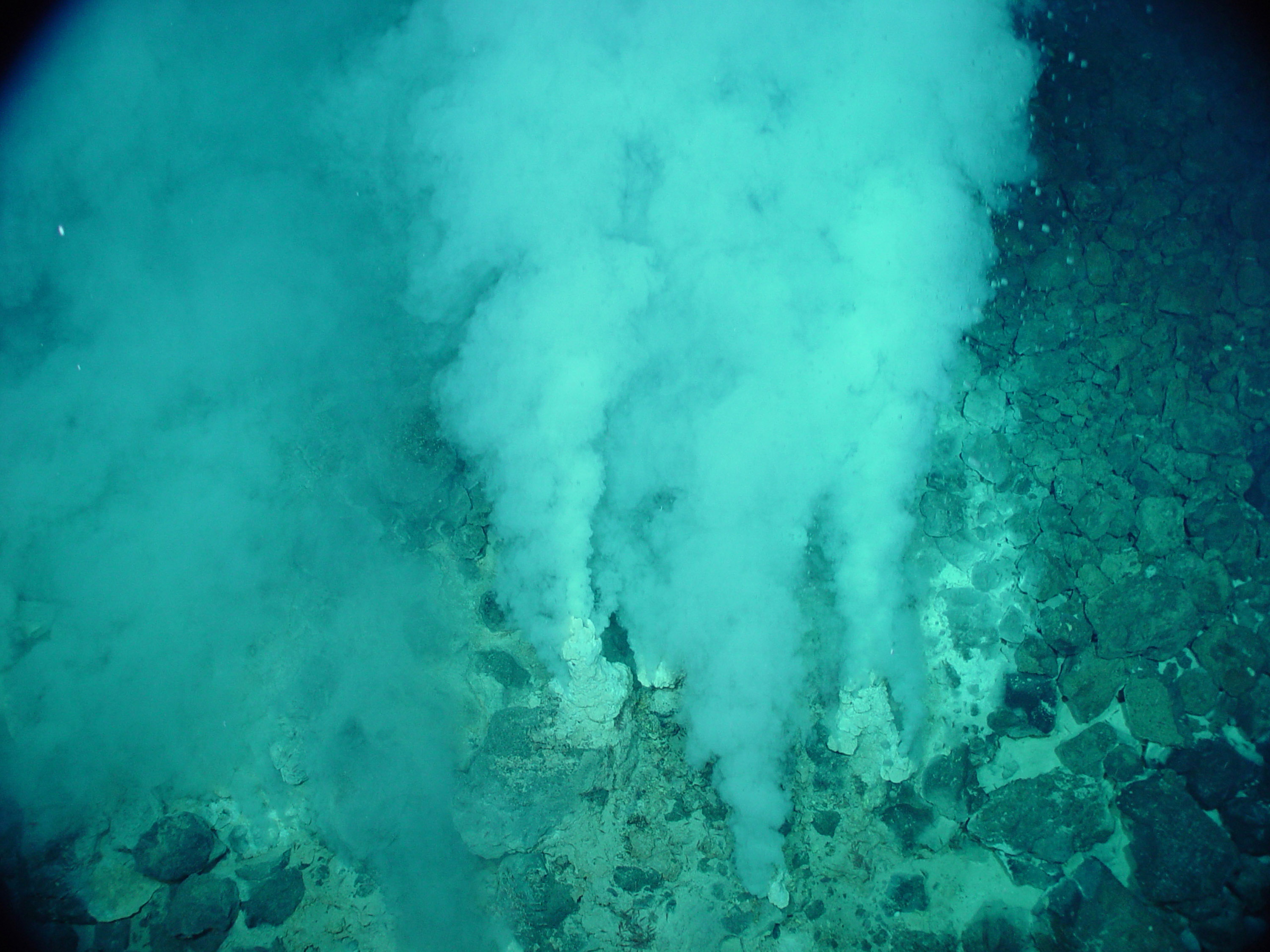
(High-temperature white smokers emitting liquid carbon dioxide from the Champagne vent in the Marianas Trench Marine National Monument. Credit: NOAA, via Wikimedia Commons.)

It's possible the first life on Earth evolved at remote "extremophile" ecosystems like deep-sea hydrothermal vents.

These otherworldly ecosystems were discovered only in 1977 by a group of marine geologists exploring the Galapagos Rift. From Deep Blue Home:

[Hydrothermal vents] form at fissures torn into Earth’s crust by our planet’s persistent rebuilding of its house, by its slow-motion rearrangement of ocean basins and continents. Much of this building takes place down the spine of the longest mountain range on Earth, the 45,000-mile underwater chain threading through the center of all the ocean basins and connecting one to the next.

 (Credit: NOAA.)

Hydrothermal vents run on a different engine than sunlight. Instead of photosynthesis, microbes use chemosynthesis to make life from nonlife inside the superheated waters of the vent. The results are incredible.

[H]ydrothermal vents are closed systems—aquariums, really, contained by walls built by temperature differences and by minerals emitted from the vents: sulfides, barium, silicon, calcium. They support highly specialized and uniquely adapted species that exist in relatively low diversity but in enormous plenty, up to 100,000 times the density of life forms on the surrounding deep-sea floor—bioabundance in an invisible box.


In this short video you can see some of the strange life forms at a deep-sea vent—including the giant tube worms whose bacterial symbionts perform the chemosynthesis fueling the foodweb here.

This is much the same relationship, btw, as the coral-zooxanthella relationship in the sunlit zone. The coral animals harbor—or enslave, depending on your point of view—symbiotic algae (the zooxanthellae) whose photosynthesis fuels the foodweb of the coral reef.


(Image courtesy of Pacific Ring of Fire 2004 Expedition, NOAA Office of Ocean Exploration, Dr. Bob Embley, NOAA PMEL, Chief Scientist.)

In the photo above, taken in 2004, scientists for the first time found hydrothermal-vent and coral-reef communities overlapping at 190 meters/623 feet. This was in the Mariana Arc region of the western Pacific. 

The image shows chemosynthetic microbial mats covering photosynthetic red algae and coral. It doesn't get any weirder or more wonderful than that.

(NW Eifuku Volcano. Squat lobsters, shrimp, and vent mussels dispersed over the bottom. Image courtesy of Submarine Ring of Fire 2006 Exploration, NOAA Vents Program.)

But for the most part, deep-sea vents live pretty isolated from the world above. Until now, that is, when they're experiencing the ultimate alien invasion—repeatedly visited and probed by beings from above.

An interesting paper forthcoming in Conservation Biology addresses the uncertain future of these deep-sea ecosystems:

Within the last 10 years, deep-sea tourism has become established at certain vent fields, and exploration has begun to measure the potential for extraction of the massive stores of sulfides in deep-sea vents that are enriched with copper, zinc, lead, silver, gold, and barium. Currently, the primary and expanding activities in vent systems are scientific, and hydrothermal vents are sometimes considered as one of the most important biological discoveries of the past century.


(A hermit crab with seep-associated fuzzy bacterial filaments on its claws, from New Zealand Seeps, a cold seep site. Image courtesy of NOAA/NIWA.)

So what impact are these visitors having on the invisible aquariums of the deep?

In 2007 the nonprofit InterRidge published a code of conduct known as the ISRRP (The InterRidge Statement of Commitment to Responsible Research Practices at Deep-Sea Hydrothermal Vents). The statement was the consensus of 2,000 researchers from more than 27 nations engaged in vent research. They concluded:

In the interest of environmental stewardship, it must be the goal of research scientists to minimize disturbances as much as possible, while still gathering the information necessary both to understand the systems and to form a basis for sustainable use strategies. Therefore, marine scientists should always evaluate their research plans from a conservative standpoint, and choose the most environmentally friendly research approach.


(Image courtesy of Submarine Ring of Fire 2006 Exploration, NOAA Vents Program.)

The authors of the paper in press in Conservation Biology are advancing the conversation with three questions:

  • What's the value of hydrothermal vents for the global scientific community?
  • Is there evidence that scientific activities are having deleterious effects on the vents?
  • How to ensure a sustainable scientific use of vents?

Using a statistical analysis of the published scientific literature, the authors compared vents to two highly-studied marine ecosystems: coral reefs and seagrass beds. The idea here is that the quantity of published papers reveals one measure of scientific value. Sure enough, vents are extremely valuable to science:

Scientific literature on hydrothermal vents is abundant, of high impact, international, and interdisciplinary and is comparable in these regards with literature on coral reefs and seagrass beds. 


(Conservation Biology. DOI: 10.1111/j.1523-1739.2010.01642.x)

The authors then surveyed scientists engaged in deep-sea research and found that although they were aware of the ISRRP code of conduct, and believed it to be relevant to conservation, they lacked confidence that other researchers were respecting it.

Respondents thought it would be difficult to be familiar with research in an area and to avoid activities that would compromise on-going studies. To facilitate adherence to this guideline, InterRidge lists locations of field campaigns and ongoing, site-specific experiments and observations, but listings are voluntary, brief, and not up to date. 

(Cable from scientific instruments, hydrothermal plume, and CO2 bubbles.  Image courtesy of Submarine Ring of Fire 2006 Exploration, NOAA Vents Program.)

Finally, the authors asked for suggestions on ways to make the ISRRP a better environmental management tool. Based on the feedback from scientists they conclude:

We believe... that scientific activities should be managed for conservation for the same reasons mining, harvesting, or tourism are managed... Scientists are often involved in evaluation of status of world natural heritage sites and, together with other stakeholders, can evaluate the status of hydrothermal vents. Because scientists benefit from these living libraries and have the potential to degrade them, they are stakeholders and we believe they have a special responsibility for exemplary behavior.


Here's a long but luminous voyage to the world of hydrothermal vents with Sir David A.

The paper:

ResearchBlogging.org
GODET, L., ZELNIO, K., & VAN DOVER, C. (2011). Scientists as Stakeholders in Conservation of Hydrothermal Vents Conservation Biology DOI: 10.1111/j.1523-1739.2010.01642.x

Tuesday, March 8, 2011

JELLYFISH RAGA


Sanskrit: rāga राग,રાગ, literally "color, hue" but also "beauty, melody."

Friday, March 4, 2011

CARL SAFINA'S EXCELLENT VIEW


I had the distinct pleasure of appearing with Carl Safina at the Song for the Blue Ocean Symposium at Oregon State University last month. One aim of the meeting was to explore whether or not scientists should use their knowledge to advocate policy change. 

The alternative—and, until recently, the status quo—is for scientists to simply deliver their results into the hands of policymakers and the public and let them hammer out our future as best they can. The flaws in that system are pretty obvious.

Safina's been a powerful pioneer in advocacy since his 1999 book Song for the Blue Ocean appeared—when he stepped out from behind the curtain of science and spoke directly to the public about the issues affecting our oceans. 

(Photo courtesy Carl Safina.)

Safina's new book, The View From Lazy Point, is a meditative journey around the world and through the seasons, from coral reefs in Belize to penguin rookeries in Antarctica—though its heart beats from the northeastern tip of Long Island. There, he writes, "I became the owner of a beach cottage that had fallen into such disrepair that I could afford it." He continues:

As much as I admire Henry Beston's classic The Outermost House, this is not a story about getting a little place out past the edge of the world and finding one's self in solitude and peace. This story is, though, partly about going home, about immersing in rhythms that come naturally... But this story's also about a kind of heartbreak for a world that remains so vitally unaware of how imperiled it is. The more I sense the miracle, the more intense appears the tragedy.

(Photo by somenametoforget, at Flickr.)

Writing about miracles and tragedies has come at a cost for Safina: The loss of his scientific research. Here's what he told me recently.

Carl Safina: I'd been studying mainly terns and their foraging ecology, until I realized that while we're learning increasingly minute things about the workings of these systems, we're losing great things like large populations of fish. So I started working on the issue of driftnets. And when the next tern field season rolled around, I realized I couldn't just quit advocacy. I thought I'd miss one field season. Then I missed two. As the marine advocacy field grew, I moved into what I do better: writing and talking. Now I get my research fix through invitations to visit scientists whose work I'm most interested in during their field seasons.

(Least tern, Sternula antillarum, with chicks. Photo by Dan Pancamo, courtesy Wikimedia Commons.)

I asked Safina where The View From Lazy Point—his fifth book, released last month—fits into the trajectory of his writing life. 

Carl Safina: I used to think my work was all about marine conservation. But the climate issue has blurred everything. You can't worry about coral reefs without worrying about the people living around coral reefs who depend on them. The climate issue has blurred the lines between our peace and security and, say, the fate of sea turtles. In The View From Lazy Point, I cast my widest net yet, following the ripple effects.


(Photo by Nhobgood Nick Hobgood, courtesy Wikimedia Commons.)

I asked Safina why we're so slow to get any traction of the global issues facing us.

Carl Safina: Our institutions are fundamentally irrational. Economics, including capitalism, our wisdom traditions, like religion, are all hundreds or even thousands of years old. They're born from a time when we thought the world was unchanging and unchangeable. Not until science came along did we understand that the world can and does change, and that we have the power to change the world for better or worse.

I asked him what themes he was working on in the book and he described one that emerged only late in the writing.

Carl Safina: That nature and human dignity require each other. When nature is destroyed—Haiti is a case in point—people can't get back on their feet and lose their ability to live a dignified life. When people are oppressed beyond human dignity, then there's no ability to care for nature.


(Photo by Fred Hsu, Fredhsu, at Wikimedia Commons.)

The View From Lazy Point is a synthesis of deep storytelling and deep thinking. Its muscular language makes for an uncommonly good read: far from doom and gloom, rich with anecdotal rewards and practical solutions. It's infused with Safina's own signature blend of fisherman-scientist-philosopher wisdom. Here's one of my favorite passages:

So I guess what I'm trying to say is that, though I'm a secular person and a scientist, I believe that our relationship with the living world must be mainly religious. But I don't mean theological. I mean religious in the sense of reverent, revolutionary, spiritual, and inspired. Reverent because the world is unique, thus holy. Revolutionary in making a break with the drift and downdraft of outdated, maladapted modes of thought. Spiritual in seeking attainment of a higher realm of human being. Inspired in the aspiration to connect crucial truths with wider communities. Religious in precisely this way: connection, with a sense of purpose.


My Ping in TotalPing.com