Showing posts with label history. Show all posts

Wednesday, July 20, 2011

THE MEMORIES OF OLD FISHERS

There's an interesting paper just out in PLoS ONE assessing whether or not the memories of old fishers could be useful to science. Specifically, whether their recollections correlate with other fisheries data from recent decades.

The authors write:

Population declines and the extinction of marine organisms may be largely underestimated due to the difficulties involved in making scientific observations. However, data sources other than scientific time-series have proven useful in providing relevant information to marine scientists in cases that are normally considered "data-poor." Some studies have used traditional (or local) ecological knowledge to reconstruct temporal population trends and discover near-extinctions of marine fauna, while studies that compare the results from scientific research with evidence based on fishers' experience have shown that both sources of knowledge give similar results and can be used to detect the essential trends.

(Photo above by Steve Evans via Wikimedia Commons.)

(Monk seal. Via.)

To investigate, the researchers delved into the memories of 106 retired trawl fishers in Italy, Spain and Greece, seeking their impressions of the abundance of long-lived marine species—dolphins, whales, monk seals, marine turtles, and sharks—in the Mediterranean.

During the interviews, the old dudes (pretty sure they were all dudes) were asked to rank abundance of these animals group during three 20-year periods between 1940 and 1999.
 
Their perceptions were based on two indicators:

  • Frequency of sightings
  • Frequency of catches (incidental or intentional) 

    (Via.)

    Specifically, they were asked about:

    • Intentional catches of dolphins 
    • Intentional catches of turtles
    • Sightings of dolphins, whales, seals, or turtles
    • Relative catches of sharks/cartilaginous fishes

    Their answers could be: "never," "occasional," "frequent," or "very frequent."


    (Trends in catches and sightings of large marine fauna, all areas combined. Credit: Francesc Maynou, et al. PLoS ONE. DOI:10.1371/journal.pone.0021818.t001. Larger view here.)

    The results were interesting. And sad.

    • The frequency of encounters between large marine fauna and fishers declined throughout the latter half of the 20th century.
    • The decline continues at the beginning of the 21st century (except in Greece, where some dolphins are experiencing population increases).  
    • The commercial catches of sharks and other cartilaginous fishes decreased significantly.  

    The authors note that the abundance of monk seal and whales was already so low in the 20th century that the interview data were insufficient for a quantitative analysis.
      
    (Angelshark. Photo by Philippe Guillaume via Wikimedia Commons.)

    Here's what the fishers' memories revealed about recent extinctions:

    [S]moothhounds Mustelus mustelus [a kind of shark] are likely to have disappeared in the Catalan Sea before 1979, and angelsharks Squatina squatina before 1959. In western Italy, angelsharks would have disappeared by the early 1980s near the mainland and the mid-1980s in Sardinia. Smoothhounds became functionally extinct in 1990 in Italy and Greece, with only sporadic records thereafter. The sturgeon Acipenser acipenser had become extinct in the North Adriatic by 1966.


    (Photo by catrien via Flickr.)

    Bottom line is that fishers are good observers and a largely untapped treasure trove of fish tales about the health of marine ecosystems.

    If we accept that commercial trawl fishers are independent observers of the marine system, [our] results suggest that the abundance of large marine fauna has decreased considerably during the 20th century in the Mediterranean Sea (in agreement with the results of other studies), and therefore fishers' observations during a lifetime of professional activity can provide a qualitative measure of this decline.

    (Photo via.)

    Fish tails welcome too.

    ResearchBlogging.org

    Maynou, F., Sbrana, M., Sartor, P., Maravelias, C., Kavadas, S., Damalas, D., Cartes, J., & Osio, G. (2011). Estimating Trends of Population Decline in Long-Lived Marine Species in the Mediterranean Sea Based on Fishers' Perceptions PLoS ONE, 6 (7) DOI: 10.1371/journal.pone.0021818

    Thursday, June 30, 2011

    RIGHT WHALES DECODED

    (Southern right whale. Credit: © Brian J. Skerry / National Geographic Stock. Via the World Wildlife Fund.)

    An interesting new paper in MEPS (Marine Ecology Progress Series) on the southern right whales of New Zealand and Australia.

    Background: All right whales, north and south, were taxed hard and early by human whalers—the "right" whales to hunt because their high blubber content made them likely to float after death and because they frequented near-shore waters.

    That made them easy to get to even in the days of rowing.

    (A painting, artist unknown, showing the hunting of right whales. La Baleine. The Whale, circa 1840. Credit: Wikimedia Commons.)

    Some 150,000 Southern Hemisphere right whales (Eubalaena australis) were killed by 19th-century whalers and by illegal 20th-century Soviet whalers—driving the species to the brink of extinction.

    Around Australia and New Zealand, hunting peaked in the 1830s-1840s, after which the species was commercially extinct.


    (Geographic range of the southern right whale. Via the Red List.)

    The latest IUCN estimate of southern right whales dates back to 1997 when they calculated a population of 7,500 individuals. 

    At that time, several breeding populations (in Argentina/Brazil, South Africa, and Australia) showed evidence of strong recovery, with a doubling time of 10-12 years.

    Which means there might be a fair few more than 7,500 whales today.


    (Southern right whale with calf. Credit: John Atkinson. Via Marine Science Today.)

    According to the authors of the MEPS paper, no right whales were seen in the waters around mainland New Zealand for 35 years between 1928 and 1963. A few slowly returned. Yet as recently as 2005 less than 12 sexually mature females were found there.

    But another group, known as the New Zealand subantarctic group, has a more robust population estimated at about 936 whales today. Forebears of this group were likely present in some small numbers even in the bleakest killing years.


    (Credit: E. Carroll, et al, via MEPS.)

    The authors of the MEPS paper wondered about the levels of relatedness between those two whale stocks in New Zealand, as well as among whales in Australia.

    They used mitochondrial DNA and microsatellite genotypes to identify 707 individual whales and test them for genetic differentiation. You can see the breakdown of that analysis in the graphic above.

    Their data, combined with historical evidence, led the researchers to hypothesize that individuals from the NZ subantarctic are slowly recolonizing mainland New Zealand waters, where a calving ground was obliterated in the 19th century.


    (Southern right whale. Via.)

    The genetic evidence also suggests that the whales of southeast Australian are a remnant stock—different from the whales of southwest Australia:


    At the onset of whaling, southern right whales, in particular cows with calves, were found across the southern coast of Australia during the austral winter (IWC 1986). There was no real discontinuity in distribution or catch records to suggest subdivision of calving grounds in this region (IWC 1986). Based on the timing of catches at shore whaling stations during the 19th century, Dawbin (1986) proposed that southern right whales undertook 2 distinct patterns of migration along the southern coast of Australia during the austral winter. The southern right whales that migrated north along the east coast of Tasmania [the small island off the southeast tip of Australia, as seen in the graphic above] moved in a northeasterly direction up the coast of Victoria and New South Wales, while those that migrated north along the west coast of Tasmania moved from east to west along the southern coast of South and Western Australia. The latter pattern is still extant, based on the movement of photo-identified southern right whales and has been termed the 'counter-clockwise' migratory pattern (Kemper et al. 1997, Burnell 2001).


    (The Southern Ocean. Credit: Connormah via Wikimedia Commons.)

    They also found evidence that New Zealand and Australian right whales mingle in higher-latitude summer feeding grounds each austral spring—making the health of those cold Southern Ocean waters as important a component of recovery as the whales' breeding efforts.

    And what epic efforts they are. Imagine a 12-foot-long penis—known colloquially as a sea snake—plus a tons' worth of testes per male. Mating becomes a sport of endurance. And sperm competition.

    But you don't have to imagine it. As usual, just for us, David Attenborough respects the privacy of none.


    ResearchBlogging.org

    Carroll, E., Patenaude, N., Alexander, A., Steel, D., Harcourt, R., Childerhouse, S., Smith, S., Bannister, J., Constantine, R., & Baker, C. (2011). Population structure and individual movement of southern right whales around New Zealand and Australia Marine Ecology Progress Series DOI: 10.3354/meps09145

    Friday, May 27, 2011

    HAPPY BIRTHDAY, RACHEL CARSON


    It's the 104th anniversary of Rachel Carson's birth. She was with us for only 56 years—not nearly long enough.

    Last year I had the privilege of writing an afterword for a fine-press limited-edition book of Carson's first published work, a lyrical essay called Undersea. The publisher of this volume is Nawakum Press, the preface by environmental historian and biographer, Linda Lear, and the illustrations by author, designer, and illustrator, Dugald Stermer.


    I'm grateful to Nawakum Press, who have been kind enough to let me post the afterward to her beautiful Undersea here.

    So, happy birthday, Rachel Carson! This is for you.

    Afterward
    It's impossible to read Rachel Carson's deeply insightful essay 75 years after its publication and not run afoul of a sad truth: that she is not here to enjoy the plethora of new revelations emerging from the undersea world. Since her death in 1964, scientific investigation has illuminated much of the "eternal night" of her abyss. Already, tens of thousands of species have been added to the 230,000 species of marine animals known by the close of the 20th century. Our discovery of these new "folks" is not the consequence of a handful of men leisurely sailing the blue, but of thousands of women and men exploring every corner of the World Ocean with deep-towed cameras, sonar, submarines, remotely operated underwater vehicles, free-swimming autonomous underwater vehicles—an ever-evolving host of technologies allowing us to know what no one in 1937 could have imagined...

    (Cirrate, or dumbo, octopod. Credit: Michael Randall.)

    This cooperative endeavor has swelled Carson's beloved catalogue of periwinkles, starfish, and crabs to include otherworldly marvels: Dumbo ocotopods who swim by flapping earlike fins; wildcat tubeworms who drill for and feed on chemicals in decomposing oil; southern elephant seals who dive a mile and a half deep in search of prey living below the cusp of perpetual darkness; shoals of fish 20 million strong, swimming in schools the size of Manhattan.


    (Tubeworms, Lamellibrachia luymesi, from a cold seep 550 meters/1,800 feet deep in the Gulf of Mexico. Photo: Charles Fisher via Wikimedia Commons.)  

    Many discoveries have emerged from abyssal ecosystems unknown to Rachel Carson. The first hydrothermal vent was discovered only in 1977. The first cold seep in 1984. Carson understood the deep was fertilized by outflows from rivers, volcanoes, meteorites, and the rain of detritus from the ocean's surface. She could not have envisioned how the gas-fueled communities of the coldest abyss could feed themselves… how extremophile lifeforms could adapt to intense pressures and a sunless world and thrive in "lifeless" conditions by harvesting chemosynthetic—not photosynthetic—energy from hydrogen sulfide and methane. 


    (Whale fall. Credit: NOAA.)

    In Undersea, Carson marvelled at the resilience of the ear bones of whales and the teeth of shark that endured all the way to the bottom of the ocean. Imagine how she would have thrilled at the 1987 discovery of whale falls—those oases created by the sunken bodies of dead whales, each home to its own extremophile metropolis gathered to feed on the fallen bonanza of skin, muscle, bone, and blubber. Whale falls today are estimated to number some 850,000 worldwide, with many millions more in the recent past, before the age of commercial whaling reduced global whale populations by 90 percent. Each fallen whale is an island of life-support with a hundred-year-plus lifespan. 

    (Lobster egg. Credit: Tora Bardal, from Nikon Small World 2009.)

    The underwater world we've discovered since Carson's day redefines the old superlatives. Today's finds are bigger, deeper, darker, colder, farther, older. Technology combined with a growing lineage of scientific knowledge allows us to explore the heretofore unknowable. We visit communities of life thriving in blackness 2,300 feet below Antarctic ice. We follow pairs of mated seabirds flying 44,000-mile figure-eight loops around the Pacific in the 200 days between their nesting seasons. We rediscover Jurassic shrimp "extinct" for 50 million years alive and well in the Coral Sea. We magnify ocean water and find bacterial species in excess of 10 million. 

    (Photo ©Julia Whitty.) 

    Our sorrow at the absence of Rachel Carson in this expansive world is mitigated by another sad truth. The same alarming developments that compelled her to sound the clarion call of Silent Spring only a quarter century after the lyrical Undersea are evolving dangerously today. Delving deeper, we find the depths suffering from overfishing, pollution, dead zones, acidification. Scrambling to uncover new species, we find them disappearing faster than we can reach them, with more than a third of scientifically assessed species now in danger of extinction. Since Carson's hand helped guide the helm, the ship of science has shifted course to sail head-on into a typhoon of human excesses: habitat destruction, biological invasions, global-warming, overpopulation. The world Rachel Carson loved and defended grows more silent spring, summer, autumn, and winter.


    (Robert Hines and Rachel Carson. Credit: USFWS.)

    In the course of her all too short life, Carson had opportunity for only one brief dive below the surface, donning an old-fashioned diving helmet to stand upright in a hard current in bad visibility. Perhaps we could indulge a small literary license and take her underwater with us now—with modern equipment in excellent conditions. If she is tentative, as many novice divers are, we can offer her our hand to hold and descend together, taking the time to clear our ears, adjust our buoyancy. Somewhere along the free fall to the bottom, perhaps as the sea fans and anemones and shoals of fish begin to come into focus, she will let go our hand. Imagine the moment: the slim figure gently kicking her fins to hover over a reef and inspect a familiar tube worm. Worries about scuba tanks and regulators now forgotten, she wafts weightless through shafts of sunlight, afloat in blue wonder, Rachel Carson home at last.


    (Credit: slattery.matt at Flickr.)

    Monday, May 16, 2011

    SEA WOMEN


    In southern Japan women freedivers have been collecting the flora and fauna of the sea for 2,000 years. Traditionally they wore only loincloths in far-from-warm waters.

    I'm not sure when or by whom these photographs were taken, but they may be the work of Fosco Maraini in his 1962 book, Hekura: The Diving Girls' Island.


    (All images above from SkindivingHistory.com.)

     'Course traditions don't get much more exciting than mostly-nude women in the water with pearls and sharks and whatnot. These divers are known as ama, or sea women, and they form a cultural bridge connecting the fantasies of all of humankind.


    (The first Ama. Via Japonisme.)

    A Japanese myth about the first ama tells of a perfect pearl stolen by a dragon king. Here's the rest of the tale, from Japonisme:

    Fujiwara no Fuhito (659-720) went in search of the pearl to the isolated area where he met and married a beautiful pearl diver named Ama, who bore him a son. Ama, full of love for their son, vowed to help recover the stolen pearl. After many failed attempts, Ama was finally successful when the dragon and grotesque creatures guarding it were lulled to sleep by music. Upon reclaiming the treasure, she came under pursuit by the awakened sea creatures. She cut open her breast to place the pearl inside for safekeeping; the resulting flow of blood clouded the water and aided her escape. She died from the resulting wound but is revered for her selfless act of sacrifice for her husband Fuhito and their son.


    Interestingly, ama improve their endurance underwater over time, peaking in their middle years, with some managing incredible longevity. According to this documentary, the oldest working diver on Hegura Island is 92 years old.


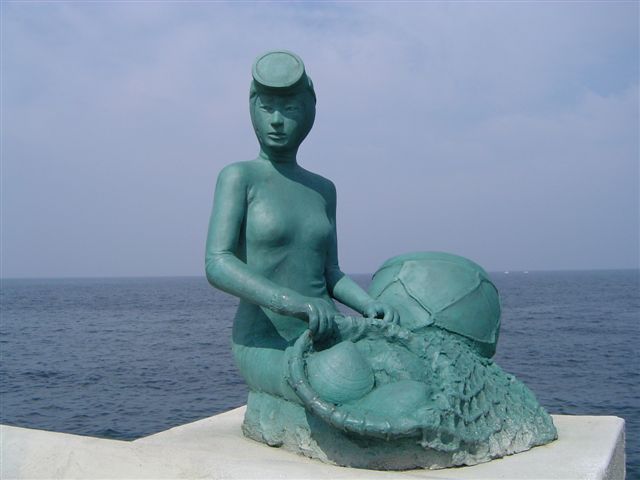
    (Haenyo, or sea women, statue in Jeju, Korea. Credit: Chosun Bimbo 2 via Wikimedia Commons.)

    Korea has women divers too—called haenyo, or sea women. Here are a few excerpts from a 1996 article in Diver magazine describing their way of life:

    At the top of a rocky cliff on the South Korean island of Jeju, several people sit motionless in the lotus position, meditating. They are dressed in shimmering black neoprene, white cotton head covers and old-fashioned, oval masks. These are the Hae Nyeo female divers, who practise a tough, dangerous profession that has continued for centuries. After meditating they will enter the sea to dive, breath-holding, for shells, tunicates, octopus, crabs, seaweeds—anything on the seabed that is edible. They hardly ever use boats, simply jumping in from the rocky coastline and swimming sometimes long distances to get to the reefs they wish to hunt...

    I enter the water with my camera. A Hae Nyeo diver hovers at the surface 15m above me, and raises her head to take her last deep breath before shooting down head first. Quick and nimble, fishlike, she glides over rocks, under overhangs and squeezes into narrow openings. Her well trained eyes quickly pick out wanted prey—shells and starfish—and she uses her piece of metal rapidly to detach them. It is amazing how long this woman can hold her breath and work hard under water. Back at the surface she puts the prey in the circle net before heading straight back down for another attempt. For an hour I observe the Hae Nyeo. Their physical performance is absolutely astonishing, each female diver heading down to depths of up to 20m about 30 times over...

    Nowadays, the Hae Nyeo divers are well respected and honoured, but this was not always so. The women were not accepted by high society. They were thought to be uneducated, wild, stubborn, much too independent, and the vocabulary they used was considered outlandish. As if this was not enough, they dared to dive into the sea half naked! The Hae Nyeo have, though, maintained a special community of their own. Their appearance and vocabulary still reflect the fact that they are tough and self-confident women.
    Despite their abilities, the female divers do get into trouble. High waves and currents can lead them to complete exhaustion, and through an interpreter I learn that one still-active 70-year-old diver has lost "many" of her female companions to the sea. Some, she says, had become stuck while trying to get a shell of extraordinary size out of an opening; and others had been taken away by strong currents. The worst accident the old female diver remembers is a shark attack, in which a female diver who must have hurt herself badly and lost a lot of blood was tracked down by a big shark and killed.

    Soon, says the elderly diver, the female divers will have disappeared for good. Despite the good money to be earned from selling seafood, young girls nowadays don't want to continue the breath-hold hunting traditions of the Hae Nyeo. A way of life that has existed for centuries could soon be gone.


    Sadly, it seems the younger women have been tamed.

    Sunday, April 3, 2011

    SUNDAY POETRY: "FIVE VIEWS OF CAPTAIN COOK"


    FIVE VIEWS OF CAPTAIN COOK
    [A fragment]
    by Kenneth Slessor

    Flowers turned to stone! Not all the botany   
    Of Joseph Banks, hung pensive in a porthole,   
    Could find the Latin for this loveliness,   
    Could put the Barrier Reef in a glass box   
    Tagged by the horrid Gorgon squint
    Of horticulture. Stone turned to flowers   
    It seemed—you’d snap a crystal twig,   
    One petal even of the water-garden,
    And have it dying like a cherry-bough.
    They’d sailed all day outside a coral hedge,   
    And half the night. Cook sailed at night,   
    Let there be reefs a fathom from the keel   
    And empty charts. The sailors didn’t ask,
    Nor Joseph Banks. Who cared? It was the spell   
    Of Cook that lulled them, bade them turn below,   
    Kick off their sea-boots, puff themselves to sleep,   
    Though there were more shoals outside
    Than teeth in a shark’s head. Cook snored loudest himself.

    (You can read this amazing poem in its entirety at the Poetry Foundation website.)

    The illustration of a coral above is by Eugenius Johann Christoph Esper from his c.1798 book Die Pflanzenthiere in Abbildungen nach der Natur mit Farben erleuchtet nebst Beschreibunge.

    That translates roughly to: "Images from nature of animal-plants, illuminated with color and descriptions." For more scans of Esper's work, see the digital gallery of Germany's Humboldt University.


    HMS Endeavour. 1768. Thomas Luny.

    Joseph Banks was the botanist/naturalist who sailed aboard HMS Endeavour on James Cook's first voyage voyage of exploration between 1768 and 1771. 

    Among their many shared adventures was a near-sinking after weeks of entrapment (occasionally escaping, only to get sucked back in by winds or currents) in the maze of Australia's Great Barrier Reef. 

    Eventually Endeavour was holed on a reef and Cook's men were forced to lay her ashore for seven weeks of repairs. Cook wrote with unusual feeling about his adventures in the coral shallows:

    It is but a few days ago that I rejoiced at having got without the Reef, but that joy was nothing when Compared to what I now felt at being safe at Anchor within it, such is the Visissitudes attending this kind of Service & must always attend an unknown Navigation where one steers wholy in the dark without any manner of Guide whatever.


    (Les Gibson. Photo by Julia Whitty.)
     
    The site of Endeavour's repairs is today known as Cooktown—home then and now to the Guugu Yimithirr people, who taught Cook's men the word ganguru (kangaroo) and who kept them alive with gifts of food and natural history lessons in an unfamiliar landscape/seascape.

    I wrote at some length about the Guugu Yimithirr and Cook's legacy in my Mother Jones article Listen to the Lionfish: What Invasive Species Are Trying to Tell Us. 

    In the photo above, Les Gibson, a Guugu Yimithirr, is showing me how to "hunt" (fish) near the place where Endeavour limped ashore 232 years earlier.


    James Cook. c. 1775. Nathaniel Dance.

    After his sojourn with the Guugu Yimithirr, after enjoying the bounty of their vibrant world, Cook concluded:

    In reality they are far more happier than we Europeans; being wholy unacquainted not only with the superfluous but the necessary conveniencies so much sought after in Europe.

    Friday, March 11, 2011

    TSUNAMIS AND QUAKES MAP, JAPAN 1900-2011


    This map shows the details of Japan's 8.9 source earthquake, 11 March 2011, embedded in a map of large quakes and tsunamis between 1900 and 2004.

    Thursday, February 3, 2011

    BURIAL AT SEA

    Seems to me that minus the embalming chemicals and coffins, burial at sea is a sensible solution to our current conundrum of more people, fewer cemeteries, dwindling land availability, and increasing air pollution and mercury contamination (think dental fillings) from cremations. 

    Why not—if we so desire—let our bodies go unclothed into the deep, to feed a foodweb running short of big bodies?

    Or if you'd rather commit your ashes to Davy Jones Locker, how about via The Shell (above)—from Lots Design of Sweden—a biodegradeable paper urn? Submarine to the great beyond.


    Another solution is offered by Hong Kong architect Tin Shun But. His Columbarium at Sea is a concept for a floating mausoleum designed for the storage of funerary urns. Or you could visit for the purpose of scattering ashes offshore.

    The columbarium is about a journey from the land to the floating resting ground, which represents the transformation of the human body into ashes. A place of collective memories, the ashes of the deceased are scattered or buried in urns. "The goal is to create an experience of 'moving on to the next'—a synthesis between horizon and the datum of the ocean celebrating the lives that are buried in this space or scattered in the sea," explained the designer.

    Would make a great scifi set.


    (All images from Arch Daily. More here.)

    The Norse, or Vikings, performed burials at sea in the course of their long oceanic voyages. 

    They also buried great kings and chieftains ashore in their own ships. A few of these ship burials have been located, excavated, and restored over the years.

    Hard to imagine anything more beautiful than the sleek lines of these ancient vessels.


    (Top two images: Excavation c.1904 and restoration of Norway's Oseberg ship. Bottom two: Excavation c.1880 and restoration of Norway's Gokstad ship. All courtesy Wikimedia Commons.)

    In The Rusiyyah, Ahmad Ibn Fadlan, a 10th-century Arab travel writer, witnessed a Viking ship burial/cremation. His tale is surely one of the more hair-raising accounts ever committed to the written word, complete with a description of a Norse version of suttee.

    Here's a snippet, translated by James E. Montgomery:

    When their chieftain dies, his family ask his slave-girls and slave-boys, "Who among you will die with him?" and some of them reply, "I shall." Having said this, it becomes incumbent upon the person and it is impossible ever to turn back. Should that person try to, he is not permitted to do so. It is usually slave-girls who make this offer. 
    When that man whom I mentioned earlier died, they said to his slave-girls, "Who will die with him?" and one of them said, "I shall." So they placed two slave-girls in charge of her to take care of her and accompany her wherever she went, even to the point of occasionally washing her feet with their own hands. They set about attending to the dead man, preparing his clothes for him and setting right all he needed. Every day the slave-girl would drink and would sing merrily and cheerfully.

    On the day when he and the slave-girl were to be burned I arrived at the river where his ship was. To my surprise I discovered that it had been beached and that four planks of birch (khadank) and other types of wood had been erected for it. Around them wood had been placed in such a way as to resemble scaffolding (anābīr). Then the ship was hauled and placed on top of this wood. They advanced, going to and fro uttering words which I did not understand, while he was still in his grave and had not been exhumed.

    Then they produced a couch and placed it on the ship, covering it with quilts Byzantine silk brocade and cushions Byzantine silk brocade. Then a crone arrived whom they called the "Angel of Death" and she spread on the couch the coverings we have mentioned. She is responsible for having his sewn up and putting him in order and it is she who kills the slave-girls. I myself saw her: a gloomy, corpulent woman, neither young nor old.

    When they came to his grave, they removed the soil from the wood and then removed the wood, exhuming him in the izār in which he had died. I could see that he had turned black because of the coldness of the ground. They had also placed alcohol, fruit and a pandora (ṭunbūr) beside him in the grave, all of which they took out. Surprisingly, he had not begun to stink and only his colour had deteriorated. They clothed him in trousers, leggings (rān), boots, a qurṭaq, and a silk caftan with golden buttons, and placed a silk qalansuwwah with sable on his head. They carried him inside the pavilion on the ship and laid him to rest on the quilt, propping him with cushions...

     It gets gory. You can read on here.


    (Ship burial of Igor the Old in 945. Henryk Siemiradzki, 1843-1902.)

    A much better idea, seems to me, is the divers' take on a ship burial offered by Eternal Reefs. Cast your cremains into a concrete artificial reef. Then sink it offshore for marine life to colonize.

    In no time at all, corals and other invertebrates will happily adhere to your hereafter.


    My Ping in TotalPing.com