Showing posts with label birds. Show all posts

Friday, October 8, 2010

RANDOM EXCERPT: FILMING FROM THE BLUFFS

(Colony of northern gannets at Cape Saint Mary's Ecological Reserve, Newfoundland. Photo by Bigg(g)er, courtesy Wikimedia Commons.)  

Cape Saint Mary's Ecological Reserve on the island of Newfoundland is one of my favorite places on Earth. 


Look at the monster continental shelf all around it. That's none other than the Grand Banks, the fishing grounds that fueled Europe for 500 years. 

Cape Saint Mary's lies on a point of land between fjords. In bird-world economics, that's like living between Costco and Home Depot.

(Photo by Johnath, courtesy Wikimedia Commons.) 

Only way bettah.


(Capelin spawned out on a beach in Newfoundland. Photo by Litehouseman, courtesy Flickr.) 

The birds are here for these waters' many piscivorous banquets, including the annual capelin feast: aka, the spawning run, known locally as the scull. This is the time each summer when capelin by the millions head up onto dry land to spawn.

More on that in a later post.
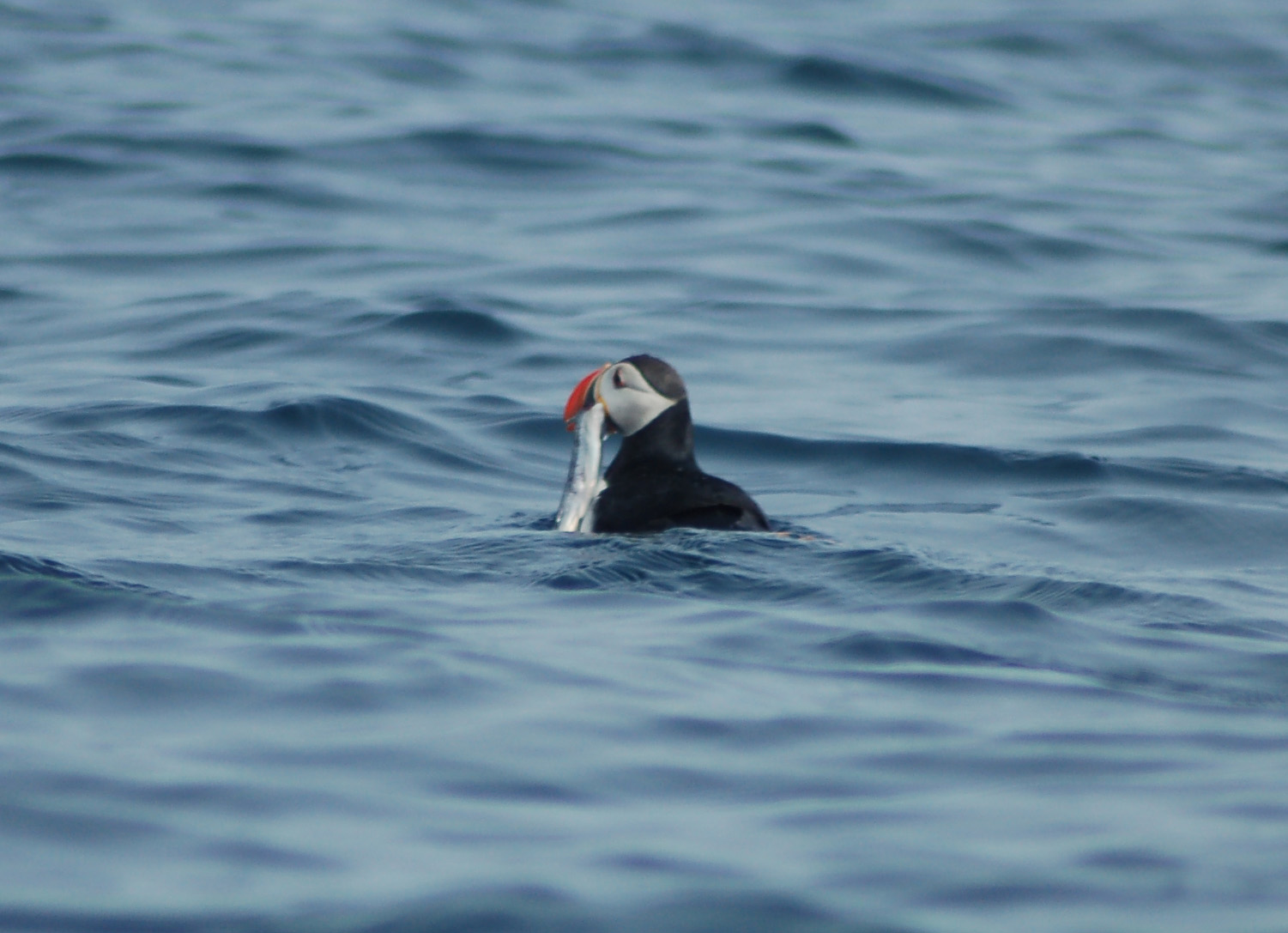

(Atlantic puffin with capelin off Newfoundland. Photo by Nilfanion, courtesy Wikimedia Commons.)

(A mated pair of northern gannets performing their courtship display, including fencing with their bills. Photo by naturepicsonline, courtesy Wikimedia Commons.)

Cape Saint Mary's is widely recognized as one of the most accessible seabird rookeries in the world, where you can see—from dry land and from as little as 30 feet away—spectacular aggregations of northern nesters:
  • 24,000 northern gannets
  • 20,000 black-legged kittiwakes
  • 20,000 common murres
  • 2,000 thick-billed murres
  • 200 razorbills
  • black guillemots
  • double-crested cormorants 
  • great cormorants
  • northern fulmars
(Northern gannet with nesting material. Photo by Andreas Trepte, courtesy Wikimedia Commons.)


(Razorbill, in similar nesting conditions to Cape Saint Mary's, in Westfjords, Iceland. Photo courtesy Wikimedia Commons.)

(Black guillemot at Oban Harbour, Scotland. Photo by Kelson, courtesy Wikimedia Commons.)

Here's an excerpt about time I spent at Cape Saint Mary's. From DEEP BLUE HOME.
Filming from the bluffs, we are buffeted by the collective voice of the birds, as rough as the sea below and likewise rising, cresting, breaking into squawks, chuckles, squalls, trills, shouts. Dr. Charles W. Townsend, visiting the gannets in 1919, described their calls as "the sound of a thousand rattling looms in a great factory."
Thousands of long-winged, long-tailed birds are woven onto the wind, white crosses billowing on veils of fog. Heads down or cocked to the side, the gannets call to their mates below, sifting through the mayhem for familiar return calls, their personal homing beacons. When heard, the receiving bird retracts its wings, extends its legs, and drops—as light as a falling handkerchief that neatly folds itself upon landing.
The great looms of the gannets are joined by other calls: the breaking-glass kitt-ih-wake! of the kittiwakes; the purring and moaning of turrs—Newfoundland for murres; the grumpy growling of razorbills; the piping and hissing of guillemots; the strangled croaks of cormorants; the adenoidal cackling of fulmars. Add to these the high-pitched peeps of chicks, including those still in the egg, yet already talking to their parents (as with the murres), and you have a fully fledged United Nations of multispecies languages—as if all the tongues you heard on the New York City subway were not just of humans but also our relatives, gorillas, chimpanzees, bonobos, orangutans, gibbons, macaques, baboons, complete with their children in utero and ex utero... a loud, loquacious, repetitive, insistent, hurried, harried, and vital discourse.
We capture as many dramas as we can crowd onto our limited allotment of film, the courtships, the copulations, the pipping of eggs, the chicks diving into the gullets of their parents, the parents diving into the thrashing waters, the varieties of flight in all its aerodynamic design, stretched on the stop-motion of the wind. With long lenses we investigate the nests of diving birds on the cliffs below in search of interesting finds from the deep. To the north, off the coast of Labrador, fishermen report nests full of pocketknives, smoking pipes, hairpins, and ladies combs, salvaged by cormorants diving onto the wrecks of old trading vessels.


(Double-crested Cormorant in breeding plumage. Photo by Mike Baird, courtesy Wikimedia Commons.)


The video is of Cape gannets—close relatives of northern gannets—feeding on the sardine run off South Africa. I had the good fortune years ago to work with the first South African film crew to land this spectacle on celluloid.


Seeing that clip was so rudely edited in mid-action, here's another.


Older film footage, but really lovely. You can see the great buoyancy of these birds and the world of wind they inhabit.

Monday, February 15, 2010

OUTTAKES: SISTER LANDSCAPES


(Satellite image of L'Anse Aux Meadows, Newfoundland, by NASA's Earth Observing System.)

I never throw away any writing. Instead I dump all discarded passages into an "outs" file. This is left over from my film editing days when the outs bin was a treasure chest of previously sorted material that you knew was good enough to have wanted once, and maybe good enough to want again, maybe even better in a new context. On tight deadlines, my "outs" writing file has proven a lifesaver more than a few times. I love the feeling of recycling words.

Working on this blog, I've been going through my "outs" file more than usual and found myself saddened that some of the good stuff that really should have been included in the new book, Deep Blue Home, got dropped. Some of it I intended to reintroduce but lost track of. Oh, well. Here's part of one passage:

"The distinctive landscape of Newfoundland has nearly identical sisters on the far side of the North Atlantic. Separated by 2,500 miles of ocean, yet connected by oceanic rivers--the Gulf Stream and its northern reach, the North Atlantic Current--the heathlands of coastal northern Scotland and southern Norway nourish the same plants and animals as Newfoundland. What appear to us as disparate continents are inescapably linked by the circulating watery bands of the deep blue home."


The graphic is by Jack Cook at the Woods Hole Oceanagraphic Institution. It shows some of the surface and subsurface currents of the North Atlantic connecting Newfoundland to Norway. From the WHOI site:

"Colored arrows approximate two of the major current systems flowing through the North Atlantic, with red representing the warm surface waters of the Gulf Stream, North Atlantic Current, and associated flows, and blue roughly representing the cooler, bottom-flowing Deep Western Boundary Current."
You can see how the waters bring the landscapes closer together, carrying messengers in the forms of marine life, birds, plant spores, insects.

This Atlantic puffin, for instance, and the fish, could be from either North America or Europe.


(Photo by Erik Christensen, courtesy Wikimedia Commons.)

The enterprising puffin is actually from Faroe Islands. 
 
These landscapes, one in Newfoundland, one in Norway, look almost interchangeable.


Top: Lodalen, a valley in Stryn municipality, Sogn og Fjordane county, Norway. (Photo by Aqwis, courtesy Wikipedia.)

Bottom: Panorama of Gros Morne National Park, overlooking Bonne Bay, Newfoundland, Canada. (Photo by Tango7174, courtesy Wikimedia Commons.)

Even the sheep have managed to cross the sea.


Monday, February 1, 2010

GORGEOUS FEATHERS

Here's one uplifting image of a lovely slideshow compiled from the BirdGuides Photos of the Year 2009 competition and showing on the BBC website. The other image are equally breathtaking.

I wrote fairly extensively about puffins in Deep Blue Home. One of my favorite passages is a memorable excerpt from the legendary ornithologist Arthur Cleveland Bent, circa 1919:

"I have often seen [puffins] emerge from a wave, fly across the trough and enter the next wave without apparent change in their method of propulsion. Again I have seen them come out of the water flying, only to plunge down into the water and continue the flight below the surface. On the surface they paddle along skillfully like little apoplectic short necked ducks and their small orange red legs are plainly visible."

My Ping in TotalPing.com